
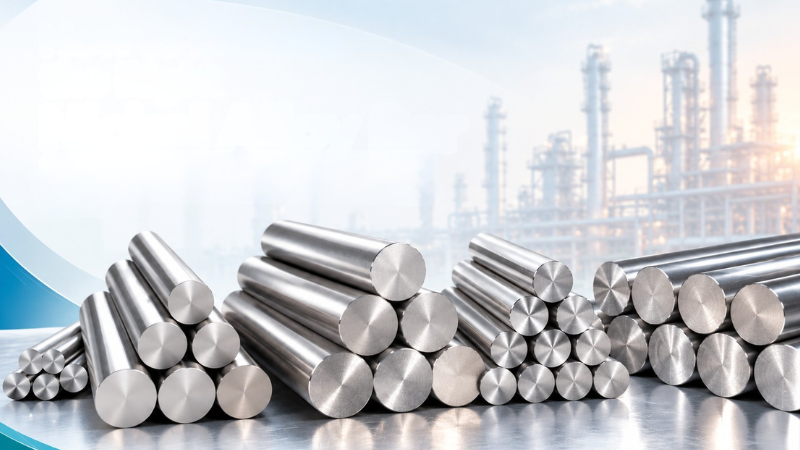
How to Choose the Right Nickel Alloy Bar for Industrial Applications
Nickel alloys are used when ordinary engineering materials may not provide the combination of corrosion resistance, temperature performance and mechanical properties required by a demanding application.
However, “nickel alloy” is not a single material category with identical properties.
Different grades are developed for different operating conditions. Maniar & Company currently lists nickel-alloy products including Alloy 400, Alloy K500, Inconel 718 and Inconel 925, alongside its stainless-steel and alloy-steel product portfolio.
For engineers, procurement teams and industrial buyers, selecting the appropriate nickel alloy bar therefore starts with understanding the service environment and required material properties.
What Are Nickel Alloy Bars?
Nickel alloy bars are solid metallic products manufactured from nickel-based alloy compositions and supplied in forms such as round bars.
They can be machined into components or used as raw material for manufacturing applications where specific mechanical, thermal or corrosion-related properties are required.
Depending on grade, nickel alloys can be considered for demanding environments involving:
- Corrosive chemicals
- High temperatures
- Mechanical loading
- Oil and gas service
- Petrochemical processing
- Power generation
- Marine environments
- Aerospace applications
The appropriate grade depends on the exact operating environment.
Why Are Nickel Alloys Used in Industry?
Nickel-based alloys are often selected because different grades can provide useful combinations of properties that are difficult to achieve with conventional steels.
Depending on the grade, these can include:
- Corrosion resistance
- Resistance to particular chemical environments
- High-temperature capability
- Mechanical strength
- Resistance to certain forms of degradation
- Suitability for demanding process environments
However, these characteristics vary significantly between individual alloys.
A material should therefore be selected based on the actual service conditions rather than simply choosing “nickel alloy.”
Step 1: Identify the Operating Environment
The operating environment should be the starting point.
Ask:
- What chemicals will contact the material?
- What is the operating temperature?
- Is the environment aqueous or dry?
- Are chlorides present?
- Is the component exposed to seawater?
- Is the material exposed to pressure?
- Is the environment reducing or oxidizing?
- Are cyclic loads involved?
This information helps narrow the potential alloy family.
Step 2: Define the Corrosion Requirement
Corrosion resistance is one of the major reasons industries consider nickel alloys.
But corrosion resistance is not universal.
An alloy that performs well in one environment may not be the appropriate choice for another.
For this reason, the buyer should provide the supplier with information about:
- Chemical concentration
- Operating temperature
- Exposure time
- Fluid composition
- Pressure
- Presence of chlorides or other aggressive species
This allows material selection to be based on the actual environment.
Step 3: Consider Operating Temperature
Temperature can significantly affect material performance.
Some nickel alloys are selected for applications involving elevated temperatures, while others are primarily chosen for corrosion resistance or mechanical performance in different environments.
Before selecting a grade, establish:
- Normal operating temperature
- Maximum temperature
- Minimum temperature
- Temperature cycling
- Exposure duration
A supplier should evaluate the grade against the complete temperature profile.
Step 4: Define Mechanical Requirements
Corrosion resistance is only one part of material selection.
The component may also need to withstand:
- Tensile loading
- Yield stresses
- Pressure
- Impact
- Fatigue
- Wear
- Vibration
The required mechanical properties should therefore be identified before choosing the alloy.
This is especially important for shafts, fasteners, machined components and pressure-related applications.
Step 5: Understand the Available Nickel Alloy Grades
Maniar’s current portfolio includes several nickel-based materials.
Alloy 400
Alloy 400 is a nickel-copper alloy commonly known as Monel 400.
It is used in applications where corrosion resistance and suitable mechanical properties are required.
Maniar lists Monel Nickel Alloy 400 among its bar products.
Alloy K500
Alloy K500 is another nickel-copper-based alloy, with properties suited to applications where higher strength is required in addition to corrosion-related performance.
Maniar lists Monel Nickel Alloy K500 in its product portfolio.
Inconel 718
Inconel 718 is a nickel-based alloy widely associated with high-performance engineering applications.
Maniar lists Inconel 718 round bars among its nickel-alloy products.
Inconel 925
Inconel 925 is another nickel-based engineering alloy listed by Maniar.
Its inclusion in the company’s portfolio supports applications requiring specialized material performance.
The exact grade should always be selected against the project’s material specification.
Step 6: Consider the Industry
The industry can provide useful context for material selection.
Maniar identifies several industries served by its materials portfolio, including:
- Oil & gas
- Shipbuilding
- Petrochemical
- Chemical
- Power and energy
- Biomedical
- Aerospace
Different industries can involve very different service conditions.
For example, a material selected for a chemical-processing component may have different requirements from one intended for aerospace or oil-and-gas equipment.
Step 7: Check the Required Standard
Industrial material procurement should be based on a defined specification.
Depending on the project, the requirement may reference:
- ASTM
- ASME
- AMS
- DIN
- JIS
- BS
- GOST
- Other customer or industry specifications
Maniar states that it can supply materials to ASME, ASTM and AMS-certified specifications and cross-reference international standards.
The buyer should therefore provide the applicable specification rather than relying only on a commercial alloy name.
Step 8: Specify the Product Form
The required form also matters.
If the component will be machined from solid stock, a round bar may be suitable.
The purchase specification should identify:
- Bar diameter
- Length
- Quantity
- Surface condition
- Dimensional tolerance
- Required grade
- Heat-treatment condition where applicable
- Certification
Providing complete information reduces ambiguity during procurement.
Step 9: Consider Traceability and Certification
Industrial applications may require traceable material documentation.
Depending on the project, buyers may request:
- Material test certificates
- Chemical composition
- Mechanical properties
- Heat-treatment details
- Inspection reports
- Product traceability
- Applicable conformity documentation
The exact documentation should be agreed before ordering.
Step 10: Consider Supply Requirements
Nickel alloys are often purchased for specialized applications, and procurement requirements can vary considerably.
Maniar states that it can provide either a single item or a complete bill of materials and emphasizes its ability to respond to inquiries involving difficult-to-find materials.
For procurement teams, useful information to provide includes:
- Exact grade
- Standard
- Size
- Quantity
- Delivery location
- Certification requirement
- End-use application
- Required delivery schedule
This allows the supplier to evaluate the enquiry more efficiently.
Nickel Alloy Selection for Oil & Gas Applications
Oil and gas applications can expose components to demanding mechanical and corrosive conditions.
Material selection may therefore involve consideration of:
- Corrosion exposure
- Pressure
- Temperature
- Fluid chemistry
- Mechanical loading
- Applicable industry specifications
Maniar identifies oil and gas as one of its key served industries and states that many of its materials are corrosion-resistant materials used in oilfield equipment.
The specific nickel alloy should still be selected based on the actual service environment and project specification.
Nickel Alloys for Chemical and Petrochemical Applications
Chemical and petrochemical environments can involve aggressive media and elevated temperatures.
For these applications, material selection should consider:
- Chemical composition
- Concentration
- Temperature
- Exposure duration
- Corrosion mechanism
- Mechanical loading
- Fabrication requirements
A generic “corrosion-resistant alloy” description is not sufficient for a technically critical application.
Nickel Alloys for Power Generation
Power-generation equipment can involve elevated temperatures, pressure and demanding mechanical conditions.
Depending on the component, the material may need to retain suitable properties during prolonged service.
The alloy grade, condition and applicable specification should therefore be established from the equipment design requirements.
Nickel Alloys for Aerospace Applications
Aerospace applications generally require tightly controlled material specifications and traceability.
Maniar states that it serves the aerospace sector and supplies materials according to recognized specifications.
For aerospace procurement, buyers should clearly define:
- Alloy designation
- Specification
- Condition
- Dimensions
- Certification
- Traceability
- Inspection requirements
Common Mistakes When Selecting Nickel Alloy Bars
Choosing by Alloy Name Alone
A commercial alloy designation does not replace a complete material specification.
Ignoring Temperature
Corrosion and mechanical performance can change with operating temperature.
Not Providing Chemical Exposure Details
The supplier needs to understand the actual environment to recommend or quote an appropriate material.
Ignoring Standards
A material should meet the project’s required specification and certification requirements.
Selecting the Wrong Condition
Where a specific heat-treatment condition is required, it should be included in the purchase specification.
Providing Incomplete Dimensions
Diameter, length and tolerance requirements should be clearly stated.
Nickel Alloy Bar Procurement Checklist
Before sending an enquiry, prepare:
Material
- Alloy grade
- Standard
- Condition
Dimensions
- Diameter
- Length
- Quantity
- Tolerance
Application
- Industry
- Component
- Operating temperature
- Pressure
- Chemical exposure
Documentation
- Material test certificate
- Inspection requirements
- Traceability
- Applicable certification
Delivery
- Delivery location
- Required schedule
- Packaging requirements
A complete enquiry helps the supplier evaluate the requirement more efficiently.
Conclusion
Selecting the right nickel alloy bar requires more than choosing a material based on its general reputation for corrosion or temperature resistance.
The correct approach begins with the operating environment, chemical exposure, temperature, mechanical requirements, industry specification and product dimensions.
Maniar & Company supplies nickel-alloy products including Alloy 400, Alloy K500, Inconel 718 and Inconel 925, alongside stainless-steel, PH-grade and alloy-steel products.
For industrial procurement, providing a complete technical specification allows the material requirement to be evaluated more accurately.
CTA: Looking for nickel alloy bars for oil & gas, petrochemical, chemical, aerospace or power applications? Share your grade, dimensions, specification and service requirements with Maniar & Company for a material enquiry.
Frequently Asked Questions
Lorem ipsum dolor sit amet, consectetur adipiscing elit. Ut elit tellus, luctus nec ullamcorper mattis, pulvinar dapibus leo.
Leave A Comment