
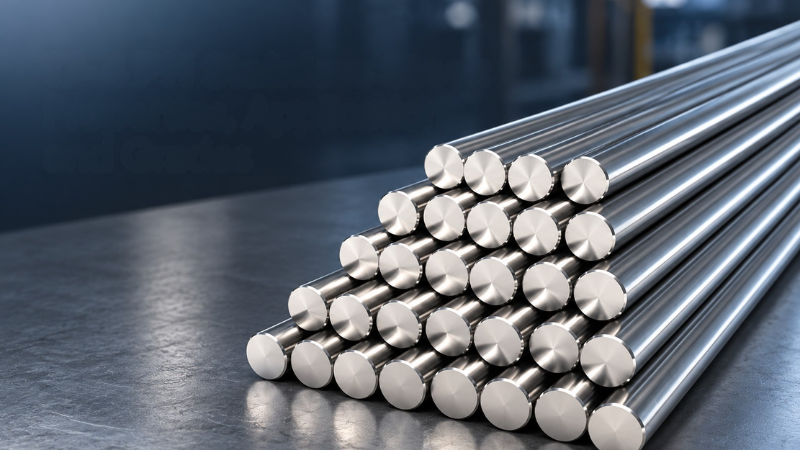
17-4 PH Stainless Steel: Properties, Applications and Selection Guide
When an engineering application requires a combination of high mechanical strength and corrosion resistance, conventional stainless steel grades may not always provide the required performance.
This is where 17-4 PH stainless steel becomes relevant.
17-4 PH is a precipitation-hardening stainless steel used in applications where mechanical properties, corrosion resistance and dimensional requirements need to be considered together.
It is available in different heat-treatment conditions, and selecting the appropriate condition is important because the final properties depend significantly on the treatment applied to the material.
For engineers, procurement teams and manufacturers, understanding the characteristics and applications of 17-4 PH stainless steel can make material selection more effective.
What Is 17-4 PH Stainless Steel?
17-4 PH stainless steel is a precipitation-hardening stainless steel.
The “17-4” designation is associated with its approximate chromium and nickel composition, while “PH” refers to precipitation hardening.
Unlike conventional stainless steels that rely primarily on alloy composition and conventional heat treatment, precipitation-hardening grades are designed so that their mechanical properties can be developed through a specific heat-treatment process.
Maniar’s 17-4 PH product section describes the material as a martensitic stainless steel that hardens through precipitation and highlights its use where high strength and moderate corrosion resistance are required.
Why Is 17-4 PH Stainless Steel Used?
One of the main reasons engineers consider 17-4 PH is its combination of properties.
Depending on the selected condition, the material can offer:
- High mechanical strength
- Good hardness
- Useful corrosion resistance
- Controlled mechanical properties through heat treatment
- Suitability for demanding engineering applications
- Availability in bar forms for machining and manufacturing
The appropriate condition should always be selected according to the actual application requirements rather than treating 17-4 PH as a single fixed-property material.
Understanding Precipitation Hardening
Precipitation hardening is a heat-treatment mechanism used to increase the strength of certain alloys.
The process involves controlled heating and cooling stages that produce a microstructure capable of providing increased mechanical strength.
For 17-4 PH stainless steel, the heat-treatment condition can therefore significantly influence the final properties.
This is why procurement specifications often identify not only the grade but also the required condition.
What Are 17-4 PH H1150 and DH1150?
Two conditions that buyers may encounter are H1150 and DH1150.
These designations refer to different heat-treatment conditions.
The material specification should therefore identify the required condition instead of simply stating “17-4 PH stainless steel.”
Maniar lists separate product offerings for:
- 17-4 PH H1150 bars
- 17-4 PH DH1150 bars
- 17-4 PH DH1150
The company’s DH1150 product page identifies its material as UNS S17400 precipitation-hardening stainless steel in the DH1150 condition and states a minimum yield-strength value of 105 ksi for that particular specification.
For procurement purposes, this demonstrates the importance of specifying the complete material requirement.
17-4 PH Stainless Steel Properties
The exact properties of 17-4 PH depend on the material condition and applicable specification.
Important characteristics considered by engineers can include:
Strength
17-4 PH is commonly selected when higher mechanical strength is required compared with many conventional stainless-steel options.
Corrosion Resistance
The material provides useful corrosion resistance for many engineering environments.
However, corrosion performance should always be evaluated against the specific environment rather than assumed to be identical across every application.
Hardness
Heat treatment can be used to achieve different combinations of strength and hardness.
Machinability
Machining requirements should be considered in relation to the supplied condition, component geometry and manufacturing process.
Dimensional Requirements
For precision components, material condition, heat treatment and dimensional requirements should be specified clearly when ordering.
Common Applications of 17-4 PH Stainless Steel
17-4 PH stainless steel is used across multiple engineering sectors.
Maniar identifies applications including pump shafts, mechanical seals, oil-related applications and aerospace applications.
Aerospace
Aerospace components can require materials with a useful balance of strength and corrosion resistance.
17-4 PH can therefore be considered for suitable aerospace components where its properties and specification meet the design requirement.
Oil & Gas
Oil and gas equipment may require materials that can withstand demanding mechanical and environmental conditions.
17-4 PH can be used for suitable components where its strength and corrosion characteristics meet the application requirements.
Pumps and Shafts
Pump shafts can experience mechanical loads and exposure to operating environments where corrosion resistance is also relevant.
17-4 PH is used for suitable shaft applications because its mechanical properties can be developed through heat treatment.
Mechanical Seals
Mechanical seal components can require controlled material properties and corrosion resistance.
The appropriate 17-4 PH condition depends on the operating requirements.
17-4 PH Bars and Round Bars
17-4 PH is commonly supplied in bar forms for machining into components.
Round bars can be used as raw material for manufacturing:
- Shafts
- Pins
- Mechanical components
- Pump components
- Fasteners
The final application determines the required diameter, condition, specification and dimensional tolerance.
What Should Buyers Specify When Ordering 17-4 PH Bars?
A procurement specification should ideally provide sufficient information for the supplier to identify the required material accurately.
Important details can include:
- Grade
- UNS designation where applicable
- Heat-treatment condition
- Diameter
- Length
- Quantity
- Applicable specification
- Required certification
- Surface condition
- Dimensional tolerance
- End-use application
Simply requesting “17-4 PH round bar” may not be enough for a technically demanding project.
Why Material Certification Matters
Industrial projects may require documentation demonstrating that the supplied material conforms to the specified grade and standard.
Maniar states that it supplies materials meeting ASME, ASTM and AMS-certified specifications and can cross-reference international standards.
Depending on the project, buyers may need documentation such as:
- Material test certificates
- Chemical composition
- Mechanical properties
- Heat-treatment information
- Dimensional inspection
- Traceability documentation
Factors to Consider Before Selecting 17-4 PH
1. Required Mechanical Properties
Determine the required yield strength, tensile strength, hardness and toughness.
2. Heat-Treatment Condition
Specify the required condition, such as H1150 or DH1150, where applicable.
3. Corrosion Environment
Consider exposure to moisture, chemicals, chlorides, temperature and other environmental factors.
4. Manufacturing Process
Machining, forging and other manufacturing processes may influence the appropriate material condition.
5. Applicable Standard
Identify the required ASTM, ASME, AMS or customer-specific specification.
6. Component Dimensions
Specify diameter, length and dimensional tolerances clearly.
7. Certification Requirements
Determine what inspection and material documentation the project requires.
Conclusion
17-4 PH stainless steel is an important precipitation-hardening material for engineering applications requiring a balance of strength and corrosion resistance.
However, the grade alone does not provide the complete material specification. The required heat-treatment condition, dimensions, applicable standard, certification and operating environment should also be established.
For applications involving 17-4 PH round bars, H1150, DH1150 or other PH-grade requirements, buyers should provide the complete technical specification to their material supplier.
Frequently Asked Questions
Lorem ipsum dolor sit amet, consectetur adipiscing elit. Ut elit tellus, luctus nec ullamcorper mattis, pulvinar dapibus leo.
Leave A Comment