
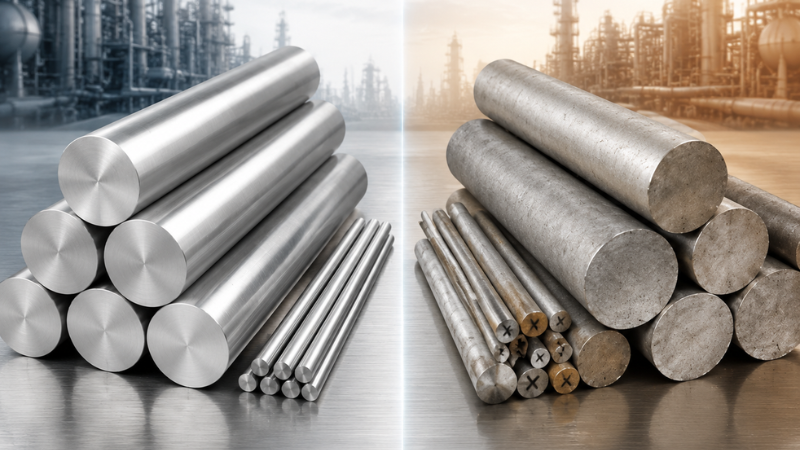
Stainless Steel vs Nickel Alloys: Which Material Is Right for Your Application?
Choosing the right material is essential for ensuring equipment performance, durability, and long-term reliability. In industries such as chemical processing, oil & gas, aerospace, marine, and power generation, material selection directly impacts operational efficiency and maintenance costs.
Stainless Steel and Nickel Alloys are two widely used engineering materials known for their strength and corrosion resistance. While stainless steel offers excellent versatility and cost-effectiveness, nickel alloys are designed for extreme environments involving high temperatures, aggressive chemicals, and severe operating conditions.
Understanding their differences helps engineers and manufacturers select the right material for their applications.
What Is Stainless Steel?
Stainless steel is an iron-based alloy containing chromium, which creates a protective layer that helps prevent corrosion and rust.
Common stainless steel grades include:
- SS 304
- SS 304L
- SS 316
- SS 316L
- SS 310
- Duplex Stainless Steel
- 17-4 PH Stainless Steel
Due to its balance of strength, corrosion resistance, and affordability, stainless steel is widely used in food processing, pharmaceuticals, construction, water treatment, and industrial manufacturing.
What Are Nickel Alloys?
Nickel alloys are high-performance materials containing nickel combined with elements such as chromium, molybdenum, iron, copper, and titanium.
Popular nickel alloy grades include:
- Inconel 600
- Inconel 625
- Inconel 718
- Monel 400
- Monel K500
- Hastelloy C276
- Nickel 200
Nickel alloys are designed for extreme environments involving high temperatures, chemical exposure, seawater, and high-pressure applications.
Stainless Steel vs Nickel Alloys: Key Differences
1. Corrosion Resistance
Stainless Steel:
Provides excellent corrosion resistance in general industrial environments, food processing, and water applications. SS 316 offers improved resistance against chemicals and chlorides.
Nickel Alloys:
Perform better in highly corrosive environments involving acids, seawater, and aggressive chemicals.
Best Choice: Nickel Alloys for extreme corrosion conditions.
2. High-Temperature Performance
Stainless steel performs well at elevated temperatures, but nickel alloys maintain strength, oxidation resistance, and stability under extreme heat.
Best Choice: Nickel Alloys.
3. Mechanical Strength
Stainless steel provides excellent strength for general engineering applications.
Nickel alloys offer superior strength under high temperatures and high-pressure conditions.
4. Cost
Stainless steel is more economical and suitable for standard industrial applications.
Nickel alloys have a higher initial cost but provide longer service life in demanding environments.
5. Fabrication and Machining
Stainless steel is easier to weld, machine, and fabricate.
Nickel alloys require specialised machining techniques due to their high strength and work-hardening properties.
Applications of Stainless Steel and Nickel Alloys
Oil & Gas Industry
Nickel alloys such as Inconel and Monel are used for valves, pumps, heat exchangers, and offshore equipment exposed to extreme conditions.
Stainless steel is commonly used for pipelines, tanks, and processing equipment.
Chemical Processing
Nickel alloys are preferred for highly corrosive chemicals, while stainless steel is suitable for less aggressive environments.
Aerospace Industry
Nickel alloys are used in engines, turbines, and high-temperature components due to their excellent heat resistance.
17-4 PH stainless steel is used where high strength and corrosion resistance are required.
Marine Engineering
Nickel alloys provide excellent seawater resistance, while stainless steel grades like 316L and Duplex are used for marine applications.
Power Generation
Nickel alloys are used in turbines, boilers, and heat exchangers, while stainless steel is used for piping and supporting systems.
Stainless Steel vs Nickel Alloys: Quick Comparison
| Feature | Stainless Steel | Nickel Alloys |
|---|---|---|
| Corrosion Resistance | Excellent | Exceptional |
| High Temperature Performance | Good | Outstanding |
| Mechanical Strength | High | Very High |
| Fabrication | Easier | More Complex |
| Cost | More Economical | Higher Investment |
| Applications | Food, construction, pharmaceuticals | Aerospace, marine, chemical, oil & gas |
Advantages and Limitations
Advantages of Stainless Steel
- 1 .Cost-effective solution.
- 2. Excellent corrosion resistance.
- 3. Easy fabrication and machining.
- 4. Wide range of grades available.
- 5. Suitable for general industrial applications.
Limitations of Stainless Steel
- 1. Limited performance in extreme chemical environments.
- 2. Some grades lose strength at very high temperatures.
Advantages of Nickel Alloys
- 1. Exceptional corrosion resistance.
- 2. Excellent high-temperature performance.
- 3. Superior strength in harsh conditions.
- 4 .Long service life.
- 5 .Resistant to oxidation and thermal stress.
Limitations of Nickel Alloys
- 1. Higher material cost.
- 2. More difficult machining.
- 3. Longer procurement timelines for specialised grades.
How to Choose the Right Material?
Consider these factors before selecting between stainless steel and nickel alloys:
- 1. Operating Temperature: Nickel alloys are better for extreme heat applications.
- 2. Corrosion Exposure: Nickel alloys perform better in aggressive chemical environments.
- 3. Mechanical Requirements: Evaluate strength and durability needs.
- 4. Budget: Stainless steel is suitable when cost efficiency is important.
- 5. Industry Standards: Ensure compliance with ASTM, ASME, AMS, or customer requirements.
- 6. Lifecycle Cost: Consider long-term maintenance and replacement costs.
Why Choose Maniar & Company?
Maniar & Company supplies high-quality Stainless Steel Bars, Nickel Alloy Bars, Alloy Steel Bars, and specialty engineering materials for various industries.
With products including 17-4 PH Stainless Steel, Inconel, Monel, and Hastelloy, the company provides materials that meet strict quality standards, dimensional accuracy, and traceability requirements.
Maniar & Company supports manufacturers, EPC contractors, and fabricators in selecting the right materials for demanding applications.
Conclusion
Both stainless steel and nickel alloys offer excellent performance, but the right choice depends on operating conditions.
Stainless steel is ideal for applications requiring corrosion resistance, strength, and cost efficiency. Nickel alloys are better suited for extreme environments involving high temperatures, aggressive chemicals, and heavy mechanical stress.
By evaluating application requirements, industries can select materials that provide better performance, durability, and long-term value.
For premium-quality stainless steel bars, nickel alloy bars, and specialty materials, Maniar & Company offers reliable solutions backed by technical expertise.
Frequently Asked Questions
Stainless steel is a versatile, corrosion-resistant material suitable for a wide range of applications, while nickel alloys are designed for extreme temperatures, aggressive chemicals, and highly corrosive environments.
Stainless steel is a versatile, corrosion-resistant material suitable for a wide range of applications, while nickel alloys are designed for extreme temperatures, aggressive chemicals, and highly corrosive environments.
Nickel alloys generally provide better strength and stability at elevated temperatures and under severe operating conditions, whereas stainless steel offers excellent strength for general industrial use.
Nickel alloys are widely used in aerospace, oil & gas, marine engineering, chemical processing, power generation, and other industries requiring exceptional corrosion and heat resistance.
Yes. Stainless steel is generally more cost-effective for standard industrial applications. Nickel alloys have a higher initial cost but often provide greater long-term value in demanding environments.
The right choice depends on factors such as operating temperature, corrosion exposure, mechanical requirements, industry standards, and lifecycle cost. Consulting an experienced supplier like Maniar & Company can help ensure the most suitable material selection.
Leave A Comment